“. . . according to the Yoga Sutra (3.1), the term [Bandha] refers to the ‘binding’ of consciousness to a particular object or locus (desha), which is the very essence of concentration.”
Georg Feuerstein

Thursday, July 28, 2011

Sitting Up Straight and Expanding the Chest Forward in Sukhasana

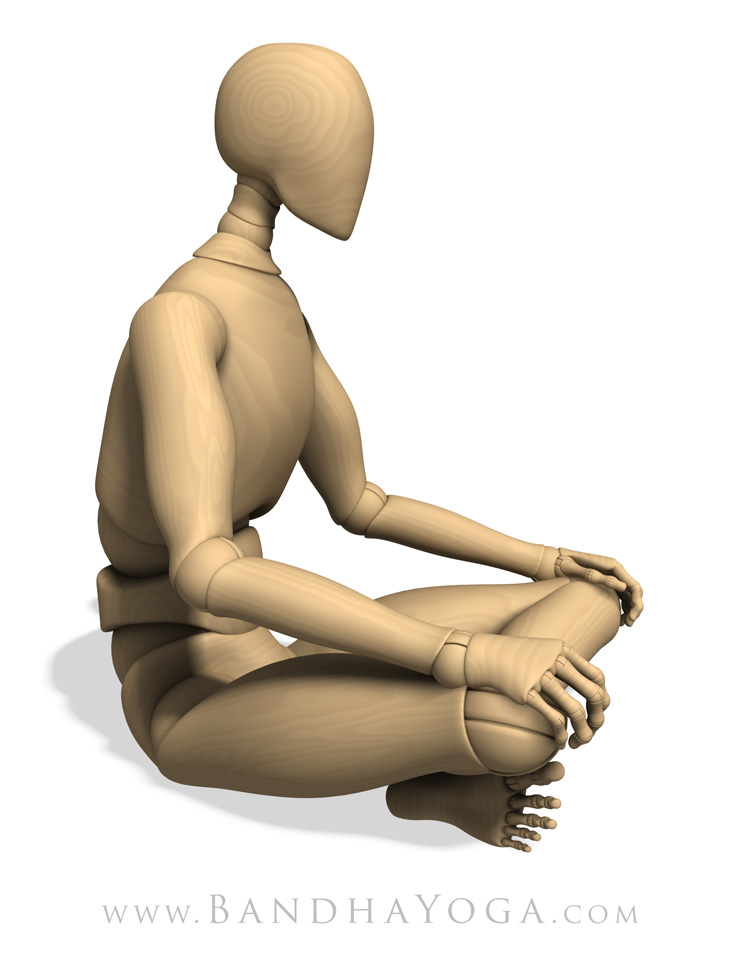
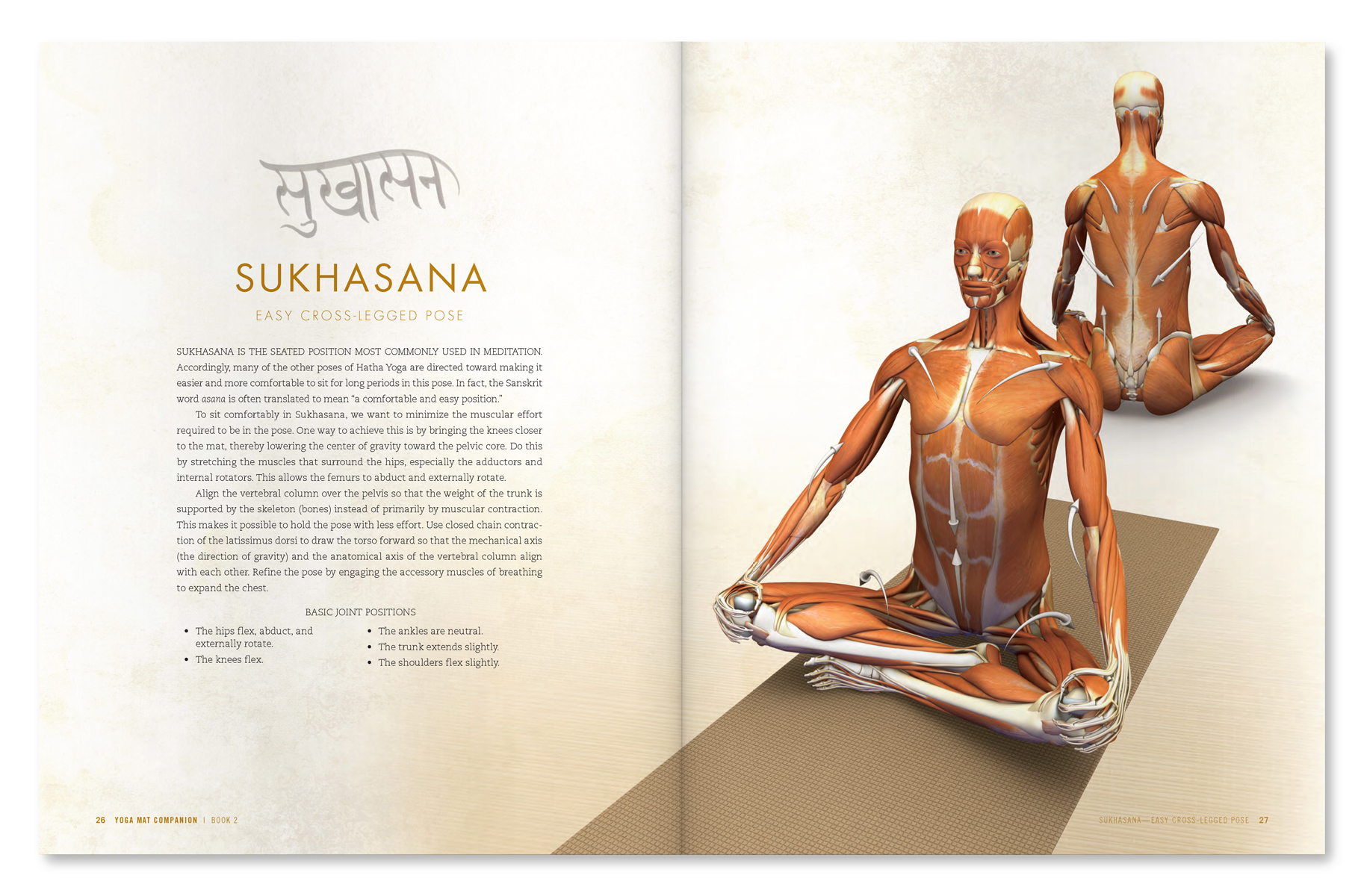
Slumping the back and collapsing the chest is a common occurrence in Sukhasana, especially in those who are new to yoga. Factors that can contribute to this posture include fatigue, defeated mental state, and tight muscle groups. Many yoga poses are designed to counteract these factors, Sukhasana being one of them. Sitting up in Easy Cross-Legged Pose aids to bring the spinal column into alignment, so that the vertebral bodies and their discs support the torso; expanding the chest forward enhances breathing. With practice this can lead to a comfortable, easy position that is reflected on the central nervous system—an example of the mind/body connection in yoga.


Here’s the Cue . . .

Place the hands with the palms facing down on the knees in Chin Mudra. Then, while holding onto the knees, attempt to draw the hands back towards the torso. This engages the latissimus dorsi. The hands are constrained, so the force of contracting the latissimus is transmitted to its origin along the midline of the back. The result is what is known in kinesiology as a “closed chain” movement, whereby the origin of the muscle moves (instead of the insertion). Activating the lats in this manner lifts the spine and expands the chest forward. If you tend to hyperextend the lumbar, then engage the abdominals to counteract this. Note the effect.


Slumping tilts the pelvis backwards into retroversion, so that one is sitting on the back part of the ischial tuberosities (the sitting bones). A portion of the latissimus dorsi originates from the back of the iliac crest, so that activating this muscle also tilts the pelvis forward, bringing the sitting bones more upright.

Lats in Tadasana
This technique is portable to other poses. In Tadasana, for example, simply fix the palms against the sides of the hips and attempt to drag them backwards. Note how the chest expands forward and the back straightens. See this concept in action for Sukhasana in the video above.

Here’s the Anatomy . . .

The latissimus dorsi originates from the spinous processes of thoracic vertebrae 6—12, lumbar vertebrae 1—5 (via the thoracolumbar fascia), ribs 9—12, the supraspinous ligament, and the posterior third of the ilium. It inserts onto the intertubercular groove on the humerus and the deep fascia of the arm. The latissimus dorsi extends, adducts, and internally rotates the shoulder (open chain movement). It extends the spine and lifts and tilts the pelvis forward (closed chain movement) and is also an accessory muscle of respiration.
Always, in your particular case, consult your health care provider before practicing yoga or any other exercise program. Always practice yoga under the direct supervision of a qualified instructor. See full disclaimer here.

Thanks for stopping by. Check back for our next post when we’ll give a finishing touch for Dog Pose. Be sure to download one of our free interactive eBooks. Also, don’t forget to tell your friends about our blog and to visit us on Facebook for your free chakra poster (we ask that you pay shipping and handling :) ).

Namasté,

Ray and Chris

Monday, July 18, 2011

Antagonist/Synergist Combinations in Yoga

In this post we explore the relationship between the tensor fascia lata (TFL) and the gluteus maximus. In addition I add a cue for engaging the adductor magnus as a synergist of the gluteus maximus. Knowledge of these relationships can be used to refine and stabilize postures with a lunge component, such as Warrior II.

The "Deltoid" of the Hip . . .

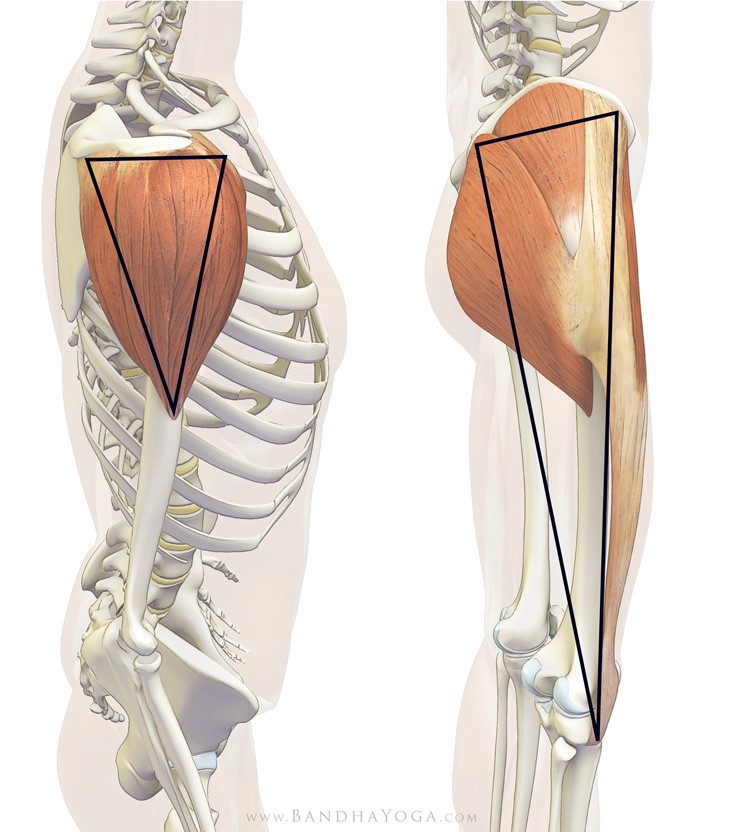
You might think of the TFL as akin to the anterior deltoid of the shoulder in that it flexes and internally rotates the joint. The gluteus maximus is similar to the posterior deltoid in that it extends and externally rotates the articulation. Both muscles can abduct the hip. They are thus antagonists for flexion/extension and rotation and synergists for abduction.

The deltoid of the shoulder and the "deltoid" of the hip.
Click image for larger view.

The gluteus medius and minimus lie between the TFL and the gluteus maximus and are comparable to the central portion of the deltoid. They are abductors and, depending on the position of the hip joint, synergists of the TFL or gluteus maximus. For example, if the hip is flexing and internally rotating, the gluteus medius and minimus synergize the TFL for these actions. If the hip is extending and externally rotating, they synergize the gluteus maximus. For this reason, the combination of the tensor fascia lata and gluteals is sometimes referred to as the “deltoid” of the hip.

The front hip in Warrior II flexes, abducts, and externally rotates. This combination of movements is known as “circumduction” and it involves the contributions of several muscles. The tensor fascia lata and gluteals produce the abduction component. Depending on the position of the joint, each of these muscles has several possible actions which can synergize or oppose one of the other muscle’s actions. Throughout the range of motion of the hip, the TFL and gluteus maximus form an antagonist/synergist pair.


Here’s the Cue . . . 

In Warriors I and II, I bring the front knee in line with the hip and ankle and then gently press the sole of the foot into the mat. This activates the TFL and gluteus maximus, respectively (the quadriceps also engage). Press the back foot into the mat to stabilize it and then gently attempt to drag it away from the front foot. This acts to extend and abduct the hip and stabilize the pelvis. I balance these cues for the front and back legs and ease back on muscular force as I attain stillness in the pose.

Engaging the gluteus maximus and tensor fascia lata in Warrior II.
Click image for larger view.

Adding the Adductor Magnus…

As an additional refinement, I engage the adductor magnus by gently attempting to drag or “scrub” the back foot inward towards the midline (adducting it). Because the foot is constrained by the mat, the force of this action is transmitted to the origin of the muscle, as shown here. I have found that this cue works especially well in Warrior I for refining the position of the pelvis.

Engaging the back-leg adductor magnus in Warrior I.
Click image for larger view.

The overall effect of these actions is to produce a series of forces that stabilize the asana from the foundation to the core. I get a feel for these cues first by using them in a shallower variation of the pose and build the muscular engagement gradually. This helps with stability and awareness.

Always, in your particular case, consult your health care provider before practicing yoga or any other exercise program. Always practice yoga under the direct supervision of a qualified instructor. See full disclaimer here.

Thanks for stopping by. Check back next week when we'll go over using these techniques in Parivrtta Trikonasana. Be sure to download our free interactive eBook. Also, don’t forget to tell your friends about our blog and to visit us on Facebook for your free chakra poster (we ask that you pay shipping and handling :)).

Namasté,

Ray and Chris

Wednesday, July 13, 2011

Balancing Freedom and Restraint in Yoga

The work of legendary furniture designers Charles and Ray Eames has been described as a balance of freedom and restraint.  Mr. Eames was once asked: “Have you ever been forced to accept compromises?” He responded: “I don’t remember ever being forced to accept compromises, but I have willingly accepted constraints.”

Practicing yoga also involves working within constraints--those of the general form of the human body and also our personal limitations. Yoga balances freedom and restraint.

Knowledge of the body shows us where to expand and where to restrict movement. It also allows us to design a practice to fit our individual needs. That’s why working with a modified version of a particular pose is not a compromise—it’s accepting constraints. I don’t abandon a beneficial asana simply because it’s difficult. Rather, I use awareness of my limitations as a guide for determining how to work in the pose.

For example, if I’m working towards Lotus Pose, I apply biomechanics and physiological reflex arcs to gain freedom of movement in the hips while at the same time using the muscular stabilizers and my hands to ensure congruency of the knee as a hinge. This is an example of balancing freedom with restraint. Since we also benefit from preparing the body for a pose, the journey itself becomes the reward.


Always, in your particular case, consult your health care provider before practicing yoga or any other exercise program. Always practice yoga under the direct supervision of a qualified instructor. See full disclaimer here.

Thanks for stopping by. Check in for our next post, when we'll go over more details on the hip abductors. Be sure to download our free interactive eBook. Also, don’t forget to tell your friends about our blog and to visit us on Facebook for your free chakra poster (we ask that you pay shipping and handling :)).

Namasté,

Ray and Chris

1De Pree, Hugh. Business as Usual. Zeeland (MI): Herman Miller; 1986.

Friday, July 1, 2011

Using the TFL to Refine Utthita Parsvakonasana

Many of the standing poses have a lunge component; that is, the forward hip and knee flex while the back hip and knee extend. It is not unusual in these types of asanas for the forward knee to drift inward, with the pelvis moving in the opposite direction. An example of this is Utthita Parsvakonasana (Extended Lateral Angle Pose).

Positioning the knee over the ankle aligns the leg bones, especially the femur and tibia. This brings the anatomic and mechanical axes closer together, so that support in the pose is derived more from the strength of the bones than from muscular effort. Additionally, allowing the knee to drift inward can place stress on the lateral compartment of the joint. Adjusting the position of the femur and the tibia aids to distribute the joint reaction forces over a greater surface area.

Click for larger image.
Here’s the Anatomy . . . 

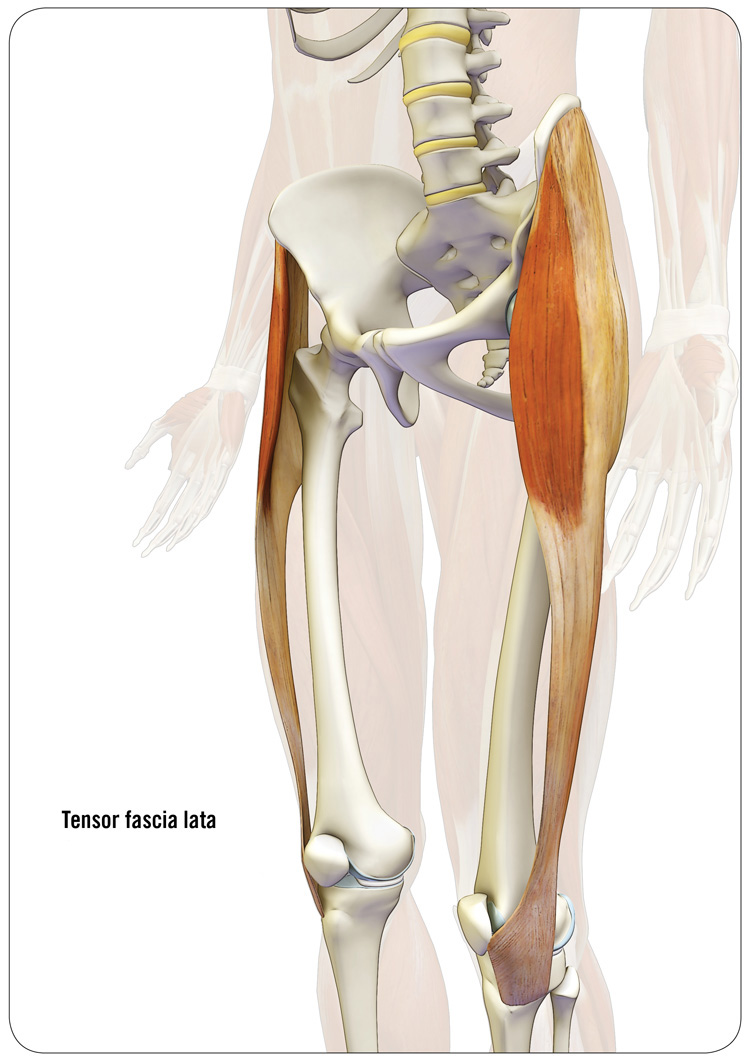
The tensor fascia lata (TFL) originates from the front part of the outer surface of the iliac crest and the anterior superior iliac spine. It inserts onto the fascia lata (iliotibial band). The fascia lata continues down the thigh to insert onto the front outside of the upper tibia at Gerdy’s tubercle. The TFL abducts, flexes, and internally rotates the hip joint. It can also synergize the quadriceps to extend the knee when it is flexing less than 30 degrees. If the knee is flexing greater than 30 degrees, then the TFL can act as a knee flexor.


Here’s the Cue

Click for larger image.
In my personal practice, I achieve this alignment by engaging the tensor fascia lata on the bent leg. To activate this muscle I straighten the elbow and then gently press the outside of the knee against the arm, as shown. This abducts the thigh at the hip joint. Because the arm keeps the knee from moving backwards, the abduction component of the TFL has the biomechanical effect of drawing the pelvis forward. This helps to open the front of the body in the asana. Additionally, activating the tensor fascia lata synergizes the psoas in flexing the hip and tilting the pelvis. Tilting the pelvis forward in this manner laterally flexes the trunk and helps to turn the torso efficiently in the pose. The gluteus minimus, gluteus medius, and gluteus maximus muscles all contribute to these actions.

I follow-up contracting the TFL with gently engaging the back-leg gluteus maximus to extend and externally rotate the hip. These combined movements aid to stabilize the pelvis and lengthen the adductor muscles.


Click here to see the TFL in action in Downward Facing Dog.

Practicing with cues that engage muscle groups enhances the mind—body connection created by the pose. I use Tadasana as a barometer to gauge this awakening by returning to it between the individual asanas.

Always, in your particular case, consult your health care provider before practicing yoga or any other exercise program. Always practice yoga under the direct supervision of a qualified instructor. See full disclaimer here.

Thanks for stopping by. Check back next week when we'll go over working with the TFL and its contributors in other poses. Be sure to download our free interactive eBook. Also, don’t forget to tell your friends about our blog and to visit us on Facebook for your free chakra poster (we ask that you pay shipping and handling :)).

Namasté,

Ray and Chris