“. . . according to the Yoga Sutra (3.1), the term [Bandha] refers to the ‘binding’ of consciousness to a particular object or locus (desha), which is the very essence of concentration.”
Georg Feuerstein

Monday, February 28, 2011

How to Balance Opposites in the Foot and Ankle

I think that one of the keys to a unified theory lies in the name Hatha—sun/moon and balancing opposites. Here’s a tip on balancing them for the foot and ankle.

First, the Anatomy . . .

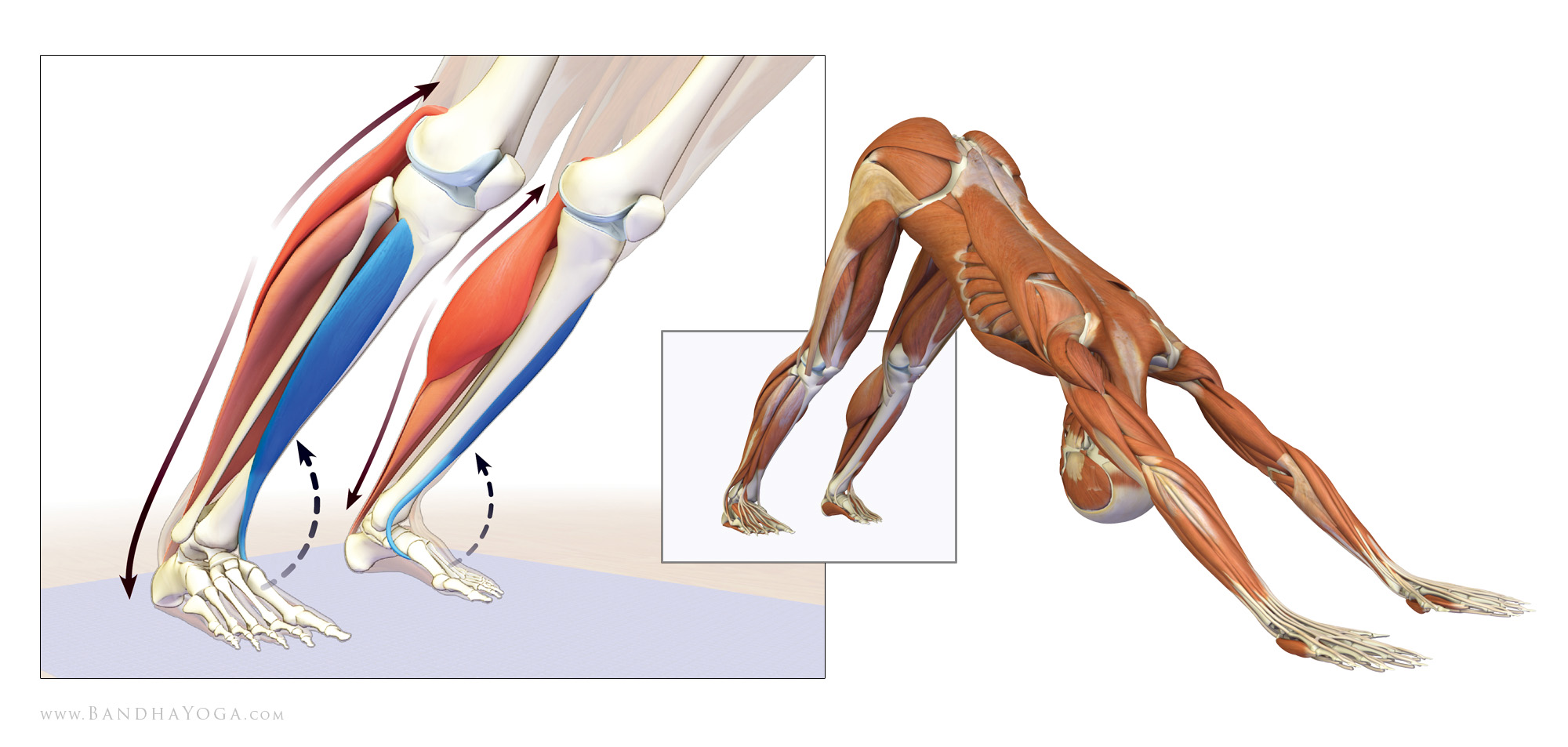
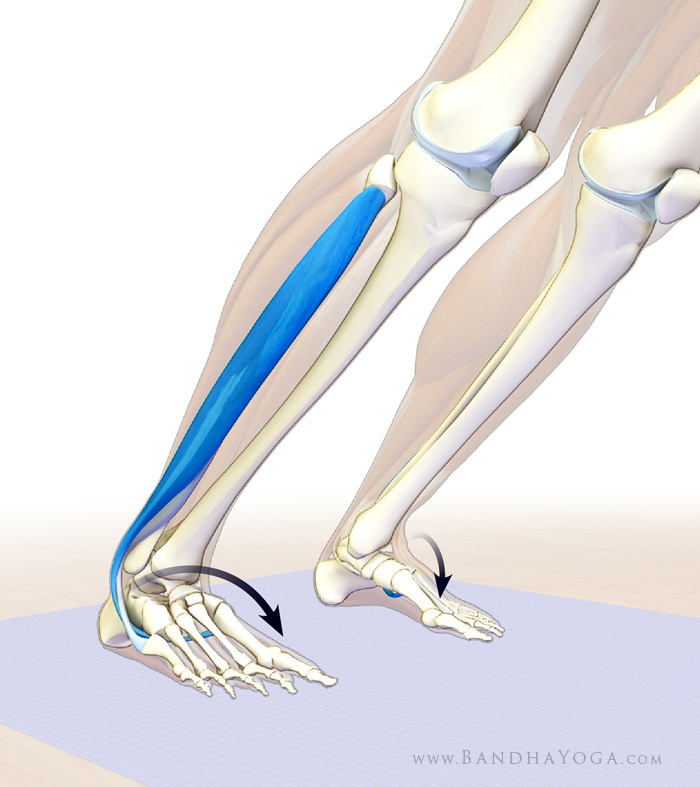
Peroneus longus (and brevis in light blue).
The peroneus longus originates from the head and upper two thirds of the fibula. It then runs down the outside of the lower leg and under the foot to insert onto the medial cuneiform and base of the first metatarsal at the inside of the foot arch. It acts to evert the foot, plantar flex the ankle, and support the transverse arch of the foot. The peroneus brevis originates from the lower half of the outside of the fibula and inserts onto the base of the fifth metatarsal (on the outer edge of the foot). It acts to evert the ankle (and assists in plantar flexing the ankle).

Tibialis posterior.
The tibialis posterior originates from the back of the upper tibia and fibula and also from the interosseous membrane that spans the two bones.  It wraps around the inside of the ankle behind the medial malleolus to the undersurface of the foot to insert onto the navicular, cuneiforms, cuboid. A fibrous expansion extends its insertion onto the bases of the second, third, and fourth metatarsals. Think “the midfoot” and use the image for reference. The tibialis posterior inverts (supinates) the foot and assists in plantar flexion of the ankle. It supports the transverse and longitudinal arches and is considered to be a key stabilizing muscle of the lower leg (by virtue of spanning between the length of the tibia and fibula).


Tibialis posterior, peroneus longus, and brevis insertions (underfoot).
Here are the Cues . . .

After you have engaged the tibiali anterior to release the gastroc/soleus muscles and lower the heels towards the floor (as described in a previous post), gently engage the peroneus longus and brevis by pressing the ball of the foot into the mat. Then activate the tibialis posterior to distribute the weight across the foot to the outer edge. Place the fleshy parts of the toes onto the mat. I will sometimes  engage the peroneii before I draw the heels to the floor. Then I activate the tibiali anterior to bring the heels down. I finish up with the tibialis posterior to spread the weight across the bottoms of the feet and dynamize the arches. Feel how this stabilizes the feet and ankles.

Remember about portability of techniques between asanas. Once you get a feeling for this in Dog Pose, try it in Trikonasana and other standing poses.

Check back for the next post where I’ll illustrate how to move this balancing of forces up through the knees and into the hips to strengthen the muscles of the thighs and align the knees. Be sure to visit us on Facebook for your free poster and e-book!!

Namasté,
Ray and Chris

Thursday, February 24, 2011

The Importance of Theory (and Another Cool Tip for Deeper Breathing)

First, I want to thank Ashtanga instructor Robin Feinberg for her comment in which she states: “…‘when the going gets tough, Ashtangis breathe deeper’; ‘as your control and depth of Ujjayi grows, so grows your practice’; and to quote Sri K. Pattabhi Jois, ‘Ashtanga yoga is 99% practice, 1% theory. Practice and all is coming.’”…

I would like to focus on the theory part of Master Jois’ iconic statement, because it is theory that informs practice. As I mentioned in the last post, for a scientific principle to be valid, it has to be reproducible by other scientists. Now, take a moment and look at our Facebook page. Go to the “people who like this” section and look at the awesome pictures of yoga on display. Some of the most amazing are Ashtanga practitioners—from all over the world. This is clear evidence of sound theory informing a practice. Master Iyengar’s alignment principles have a similar scientific foundation. Aligning the joints maximizes joint congruency. This decreases the incidence of joint reaction forces being concentrated over a small region of cartilage and helps to prevent injuries in yoga. The same goes for his advice on pranayama (see below).

BTW, I searched Pubmed and found some scientific articles that support the safety and efficacy of deep breathing techniques, especially for the management of hypertension (high blood pressure). I share them with you here. The first discusses the beneficial effects of exercise and respiratory training for patients with severe pulmonary hypertension. The authors conclude, “This study indicates that exercise and respiratory training as add-on to medical treatment may improve exercise capacity and QoL (quality of life), and that they have a good long-term safety…” The next concludes that “Respiratory retraining using the slow breathing technique appears to be a useful adjunctive for cardio respiratory control in hypertensive patients. The third is entitled “Breathing Control Lowers Blood Pressure” (‘nuff said). You can click through the links to read the full articles. So, we're beginning to see confirmation of practices the yogis have been doing for some time now—exciting stuff! 

Bear in mind that anything as powerful as pranayama can also have adverse effects if practiced recklessly. You can find details of these effects and how to avoid them in B.K.S. Iyengar’s Light on Pranayama (the bible for pranayama). I also had the privilege to discuss my personal experience of some of these effects with Yogacharya Iyengar himself (trembling, salivation, headache). He gave me this pearl: “If you feel these effects, stop for the day. If you don’t feel them, continue on with your practice.”

On to the Tip . . .

Another way to validate a theory is with a concept known as portability. In general, something that works in one lab should work in another (or it is suspect). What does this have to do with yoga? Sound biomechanical theories, such as PNF and reciprocal inhibition, can be incorporated into whatever style you practice and transported across muscle groups as well. On a smaller scale, something that expands the chest in one pose should work to enable a deeper breath in another pose.

Using the accessory muscles of breathing
to expand the chest in Dandasana.
Let’s apply the concept of portability to our practice. Try the cue for activating the accessory muscles of breathing that we illustrated in Tadasana (see “A Cool Tip for Deeper Breathing in Yoga”) and apply it in Dandasana. As you inhale, engage the triceps to extend the elbows and press your hands into the mat. Draw the shoulder blades towards the midline with the rhomboids and middle trapezius and then attempt to drag the hands apart to activate the serratus anterior. Feel how this expands your chest. Release during your exhalation. Refer here for the anatomy particulars on these muscles—they work the same in this as in other poses (an example of portability). Take a look at our free e-book to see how you can use portability for other biomechanical principles, such as reciprocal inhibition and PNF.

Cool, so I’m on to my practice. Check back next week for some info on agonist/antagonist relationships. Be sure to visit us on Facebook for your free e-book and poster.

Namasté,

 Ray

Monday, February 21, 2011

Here’s a Tip to Help You Get the Heels Down in Dog Pose

For something to be scientific, it has to be reproducible by another scientist. That’s why I want to express my thanks to all of you who have shared your experiences with these techniques on our Facebook pageFor example, I love the blog. My students appreciate the ‘new’ way that I explain how to move deeper into poses and you always get the credit. Myself, I was doing some of the things you describe naturally; I just couldn't explain them to my students. Like moving the feet away in Uttanasana to open the hips—brilliant! I never connected what I was doing to my feet. I thank you and my students thank you!"

Scientific instructions should work for any style of yoga, in any country. In this case, when you press the feet into the mat and attempt to drag them apart, you activate the gluteus medius and tensor fascia lata. This will automatically produce the effects described by Sue and in our free e-book. So it’s an honor to see this technique being validated. Truths like this exist independent of any individual (including me), but it sure feels good to be acknowledged! 

Namasté Sue!  See you in Scottdale, PA, for the workshop in May.

Now on to the Post . . .

Say you’ve been working hard on your Downward Facing Dog and still can’t get your heels to the floor. This cue can give you and your students that extra bit of length in the calf muscles and enable you to lower the heels.

First, warm up a bit with five or six Sun Salutations (Surya Namaskar A).  This has the physiological effect of acclimating the muscle spindle stretch receptors of the muscles that lengthen, including the calves. Then take Dog Pose and attempt to draw the top surface of the feet towards the shins. This contracts the tibialis anterior muscle (and its synergists), dorsiflexing the ankles. It also signals the muscles at the backs of the calves, the gastroc/soleus complex, to relax through reciprocal inhibition, enabling the heels to lower to the floor. At the same time, engage the quadriceps to straighten the knees and the triceps to straighten the elbows. These actions synergize lowering the heels. We illustrate stepwise tips like this for all kinds of poses in the Mat Companion series. Click here to page through the books.

Tibialis anterior dorsiflexing the ankles to lower the heels (gastroc/soleus lengthening).


Here’s the Anatomy . . .

First let’s look at three muscles that move the ankle: the gastrocnemius, soleus, and tibialis anterior.

The gastrocnemius has two heads: one originates from the back of the femur above the medial femoral condyle, the other from above the lateral condyle. The soleus originates from the head and upper part of the fibula and the upper third of the inside of the tibia. The gastroc and soleus combine to form the Achilles tendon, which inserts onto the back of the calcaneus (heel bone).

For the purposes of this post, the main action of the gastrocnemius/soleus complex is to plantar flex the ankle. Plantar flexion increases the angle between the shin and the top of the foot, as when pushing off during walking. Thus, a tight gastroc/soleus complex can keep you from getting the heels to the floor in Dog Pose. (The gastrocnemius also flexes the knee).

The tibialis anterior is a muscle on the front of the shin. It originates from the lateral (outside) surface of the tibia and the interosseous membrane (which spans the bones of the lower leg). This muscle inserts onto the inside part of the midfoot (the cuneiform) and the first metatarsal (think of the inner middle part of the foot arch). It acts to dorsiflex the ankle, decreasing the angle between the top of the foot and the shin.

The gastroc/soleus and tibialis anterior muscles form an agonist/antagonist pair; i.e., they have opposite actions. This means that contracting one side helps to relax the other (through reciprocal inhibition). That is why attempting to draw the top of the foot towards the shin helps release the calf and enables you to bring the heel closer to the floor. 

Thanks again for your feedback! Check back for the next post, when we’ll show you a cool tip for stabilizing the ankles once you have the heels down. Oh yes, and be sure to visit us on Facebook for your free poster and e-book. Keep the comments coming. We love ‘em!

Namasté,

Ray and Chris

Friday, February 18, 2011

A Cool Tip for Deeper Breathing in Yoga

First, heartfelt thanks for all of your “likes” and comments on our Facebook page. Enjoy the free e-book, Anatomy for Yoga, Tips and Techniques
Book 1
!
We’ve heard from practitioners all over the world on how these techniques have enhanced their practice and teaching. This is music to our ears. To show my appreciation, I want to offer a tip that can help you dramatically expand the chest. This cue on engaging the accessory muscles of breathing can provide a quantum leap in the global effect of your yoga practice. First, a little background . . .

As many of you know, I studied yoga for an extended period at the Ramamani Iyengar Memorial Yoga Institute in Pune, India. The Iyengars are true world experts in yogic breathing. During my time there, I was exposed to great teachings of pranayama from Yogacharya Iyengar, his daughter Geeta, and son Prashant. These classes were amazing; their effect would last for days.


I continued to practice pranayama when I returned from India and gradually developed an understanding of the art. During this process, I used my medical training to analyze the breathing techniques. I found that I could use Western science to amplify the effects of pranayama.

Now, part of pranayama involves breathing deeply. The body has a group of muscles that it recruits when we need to take deeper breaths, say after running a sprint. Recruiting these muscles expands the chest to a greater extent than when using the diaphragm alone. The result is increased inspiratory volume and improved lung ventilation (on the alveolar level). It occurred to me that intentionally engaging these breathing muscles would augment the volume of my inhalations during pranayama and asana practice. So I developed a series of cues to activate the various accessory muscles and incorporated them into my practice. The effect was immediate and amazing. After my practice was finished and throughout the day, my breathing felt effortless, leaving me energized.
How cool is that?

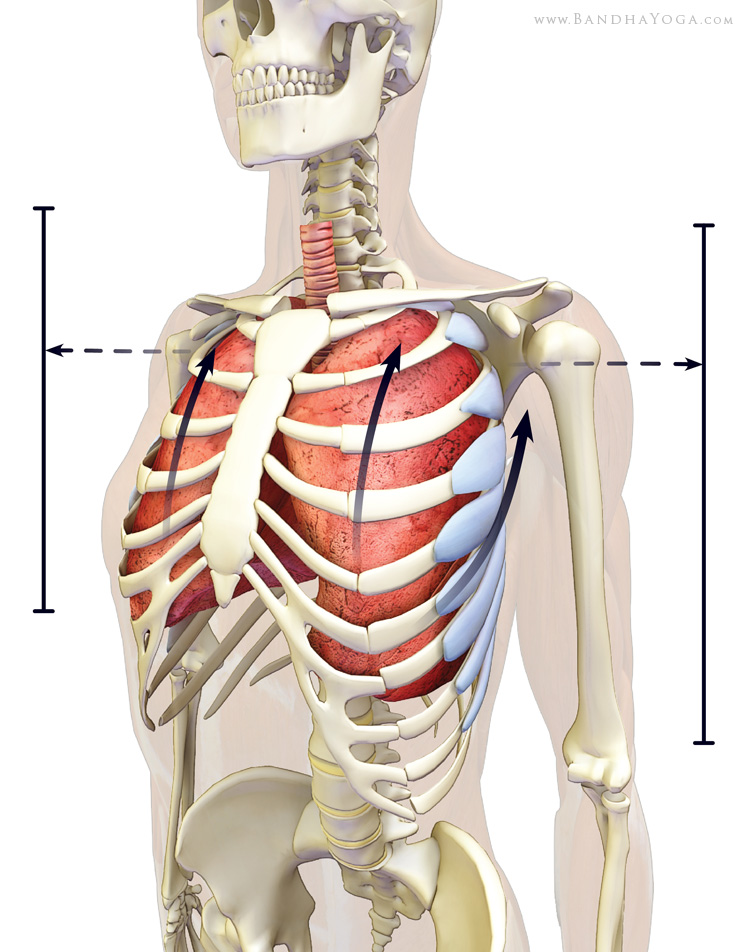
Activating the serratus anterior
to expand the lungs.
So, here’s a cue for activating one of my fave accessory muscles—the serratus anterior (SA) and his buddies, the rhomboids. Pause for a second. Rest your hands on your thighs. Now, exhale naturally and then gently draw the shoulders back to bring the scapulae (shoulder blades) towards the spine. As you inhale, imagine pressing the sides of your shoulders and upper arms against an imaginary wall, like a doorframe. Feel how this expands your chest. Repeat this cue two more times before reading on . . .

Okay, Welcome Back . . .

The rhomboids (major and minor) originate from the spinous processes of cervical vertebrae six and seven and thoracic vertebrae one through four. They insert onto the medial border of the scapula and act to stabilize and draw the shoulder blades towards the midline. The serratus anterior originates from ribs one through nine and inserts on the inside of the entire medial border of the scapula. If the scapula is fixed (by engaging the rhomboids) then contracting the serratus anterior lifts and expands the ribcage. Just focus on this action for the moment. (When the shoulder blade is released, the SA rotates and draws the scapula laterally—but that’s another blog postJ.)

Ok, now repeat the steps from above—take a relaxed exhale, then draw the scapulae towards the midline and stabilize them there using the rhomboids (feel how this expands the chest forward). Then as you inhale, attempt to press the shoulders outwards against an imaginary wall. Take a relaxed exhalation and repeat two more times.

Rhomboids stabilizing
the scapulae.
Do you notice how it’s easier to engage these muscles the second time around? That’s why I asked you to take a break, read about the anatomy, and then try it again. During the brief period you were reading, your unconscious brain formed new circuitry to activate these important muscles more efficiently. To see this process of chest expansion in action, we’ve created a video that illustrates this concept with the rhomboids and another accessory muscle of breathing, the pectoralis minor. This will give you an idea of how the ribcage expands when activating the accessories.

Use this cue when you practice this weekend. For example, as you do Surya Namaskar, when you inhale to raise your arms overhead from Tadasana, imagine pressing the shoulders outwards against a wall. Try it in other poses as well, such as Up Dog, Down Dog, and so on. This technique is especially effective for Vinyasa Flow—you guys will be floating!

Life is for enjoyment, friends, so enjoy this technique. Keep the comments coming on Facebook and be sure to visit us for your free e-book and chakra poster!

Namasté,

Ray

Wednesday, February 16, 2011

Combining Science and Yoga—Some Personal Reflections (and a FREE E-Book!)

In this blog post, I go over some of my own experiences with combining Western science and yoga, but first we wanted to let you know that we’ve consolidated our blog posts to date into a free e-book. You can view this book here or by “liking” us on Facebook. Feel free to spread this useful information around the yoga community by sending the e-book link to your friends, students, and colleagues.

Also, click here to read Eryn Kirkwood’s account of using the Mat Companion series in her personal practice, and visit German instructor Ursula Wenzel’s blog detailing her experience with our work (and see her excellent asana practice).


On to the Post . . .

Folks sometimes ask what prompted me to analyze the asanas from a biomechanical perspective. Well, I’m of an inquisitive mind, and I like to know the scientific basis for why I do something. When I began practicing yoga back in the day, it was not as accessible as it is now. I would travel far and wide to take classes wherever I could.  During this process, I noticed that the instructions for a given asana seemed to vary among different teachers and were at times contradictory. Sometimes both instructors were “correct” but for different reasons, which was confusing to me as well. Through it all, I met some great teachers and enjoyed the experience of yoga expanding throughout the world.

As I began to develop my own practice, I found myself having to memorize innumerable details for each pose in order to do the asanas “right.” So I explored the other side of the spectrum—systems that advocated applying a global set of alignment principles to all of the poses. My experience was that these principles were so global as to have little meaning to me for practicing the individual asanas, especially the asymmetrical ones (i.e., most of the poses). I wound up having to memorize countless details on how to apply these “global” principles to each individual pose. In other words, I was back to square one. It occurred to me that many of the instructions were two steps removed in their expression from what was happening biomechanically.

All the while, I was asking myself questions like, “If the back hip is extending in Warrior I, why not just say, ‘extend the back hip’?” Or better still: “Engage the buttocks to extend the back hip” (engaging the buttocks automatically extends the hip). I sought a more direct and efficient way to learn and teach the art—a systematic approach for applying general scientific principles to each asana. This differs from an individual approach to each asana or a global approach to all of them.

So I began to analyze the positions of the major joints in the poses—the hips, knees, shoulders, and elbows, etc.  Once I understood the general form of the asana, I would shift my focus to the individual joints and the muscles that produced that form in the pose. For example, if the hips were extended, then I would intentionally engage the gluteals; if the elbows were straight then I contracted my triceps, and so on. This is key—focus on what the major joints and their muscles are doing and the asana will emerge. In a pose like Janu Sirsasana this might be as direct as engaging the quadriceps of the straight knee and the hamstrings of the bent one.

Lo and behold, my poses improved, enhancing the effects of my practice and especially Savasana. This direct approach was a revelation because it saved me from having to memorize innumerable alignment tips in the individual postures. I simply started engaging the muscles that created the form of the asana and found that the bones aligned automatically. This works because the muscle attachments (the origins and insertions) have evolved to move the joints perfectly. Put another way, the body is made for yoga, and yoga for the body.

These investigations led me to develop the Bandha Yoga Codex, a simple five-step process that can be applied to any pose to improve strength, flexibility, and precision—no matter what style of yoga you practice. You can learn more about this by clicking through the Mat Companion series on the right-hand side of this page.

Thanks for stopping by. In our next post, we’ll give some tips on how to integrate anatomy into your personal practice and teaching. Be sure to visit us on Facebook for your free Chakra poster

Namasté,

Ray

Thursday, February 10, 2011

How to Draw the Knees to the Floor in Baddha Konasana

In Yoga Mat Companion Book 2 (Anatomy for Hip Openers and Forward Bends), I mention an old Chinese proverb that says, “If you are unable to attain a goal, do not abandon the goal. Rather, change your strategy to reach it.” A specific example of this would be working to bring the knees closer to the floor in Baddha Konasana (Bound Angle Pose). Say you have tried pressing on the knees, putting weights on them, etc., and you can’t get the results you want. Perhaps it’s time for a change of strategy . . .

I teach the following technique in my workshops, both to illustrate how spinal cord reflex arcs function and to help practitioners bring their knees closer to the floor.

Analyze Your Pose

We’ll use the Bandha Yoga Codex to analyze the asana. This is a simple process that you can apply to any pose to improve flexibility, strength, and precision—no matter what style of yoga you practice. Let’s focus on the lower extremities in Bound Angle Pose. Begin by looking at the general form of the pose. The hips flex, abduct, and externally rotate and the knees flex. Next, look at the muscles that engage to produce this position. The hip abductors (and their synergist, the sartorius) draw the knees apart and towards the floor. The external rotators turn the thighs out, and the hamstrings flex the knees. I usually start my work on a pose by gently engaging these muscles—I call them the synergists of the asana. This stimulates the brain centers associated with the muscles and joints and creates an imprint on the homunculus. It essentially says to the brain, “Baddha Konasana.” This is an example of the mind—body connection in yoga. Next, determine which muscles are stretching. These will be the antagonists of the muscles that produce the form of the asana. Click here to better understand agonist/antagonist relationships. The muscles that stretch in a pose are the same ones that can limit openings. In the case of Baddha Konasana, tight adductors of the hips (muscles that act to draw the knees together) can restrict lowering the knees towards the floor.

Once you have identified the muscle group that is stretching, apply your knowledge of physiology to create length in those muscles. Below is the technique for using PNF to stretch the adductors in Baddha Konasana. This works nicely to bring the knees closer to the floor (some students say it’s like magic).

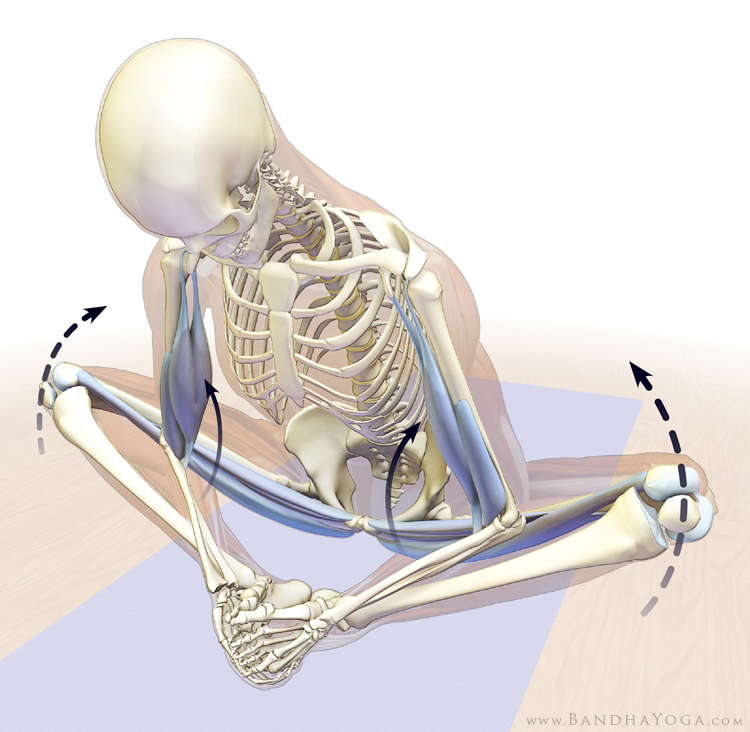
Engage the biceps to constrain the thighs.
Engage the adductors for PNF.
Apply Proprioceptive Neuromuscular Facilitation (PNF)

Take the general form of the pose. Grasp the feet with the hands and bend the elbows to place them in the crease between the lower legs and thighs. Activate the biceps and brachialis muscles to flex the elbows a bit further. This will bring the knees a little lower and stretch the adductors out to their “set length.”

Keep the biceps and brachialis engaged and then contract the adductor group. The cue for this is to attempt to lift the knees and draw them towards the midline. The elbows will prevent the thighs from moving, but activating the adductors will stimulate the Golgi tendon organs at their muscle-tendon junction. Hold this contraction for five to six smooth deep breaths, using a maximum of about 20 percent of your force. Then relax the adductors and gently activate the tensor fascia lata and gluteus medius (muscles that abduct the knees towards the floor). A cue for this action is to press the soles of the feet together.

Engage the TFL and gluteus medius to abduct
the hips and stretch the adductors.
Engage the hamstrings to flex the knees.
Lastly, engage the hamstrings by squeezing the lower legs into the thighs and bringing the heels closer to the pelvis. This helps to maintain the integrity of the knee joint

Repeat this entire process once more before coming out of the pose. Don't worry if your thighs do not come all the way down to the floor. Rather, look for improvement in the pose and then work on it again in subsequent practice sessions.

Balance Opposites

Now take Dandasana. This balances the stretch of the adductors by engaging them to bring the legs together—just as Hatha Yoga balances the Sun and Moon. Don’t worry if you can’t get your knees down immediately. Rather, look for progress. Remember to allow 48 hours for muscle recovery and then go through this sequence again.

We appreciate everyone’s feedback and thank all of you who have “liked” us on Facebook. This keeps us going and helps spread our work throughout the social network. The offer still stands: a free copy of our iconic chakra poster when you visit us on Facebook (we simply ask that you pay for shippingJ). Click here for more information. Big thanks to everyone who has shared The Daily Bandha with their friends on Facebook.

Have a great weekend, and let us know how this technique works for you. Learn more about the Bandha Yoga Codex and how to refine hip openers and forward bends in Yoga Mat Companion Book 2.

Namasté

Ray and Chris

Monday, February 7, 2011

How to Release the Hip Internal Rotators for Padmasana (Lotus Pose)

In The Key Muscles of Yoga, I point out that athletes experience improved performance and fewer injuries when they have a fundamental knowledge of their anatomy and biomechanics. For this reason, I recommend that you add The Daily Bandha to your favorites and return every day or so to review one or two of the concepts presented here. This will allow you to integrate these tools into your yoga practice. After just a few sessions, you’ll begin to apply the techniques unconsciously, improving your poses and aiding to prevent injuries.

In our last post, we discussed the concepts of joint congruency and joint reaction forces as related to yoga. These are among the most important principles to understand for both practitioners and teachers, because many poses can take the articulations to the limits of their range of motion. Take a moment to review this post and look at the new video which shows these concepts in action in Padmasana (Lotus Pose).

Now, on to releasing the internal rotators of the hip . . .

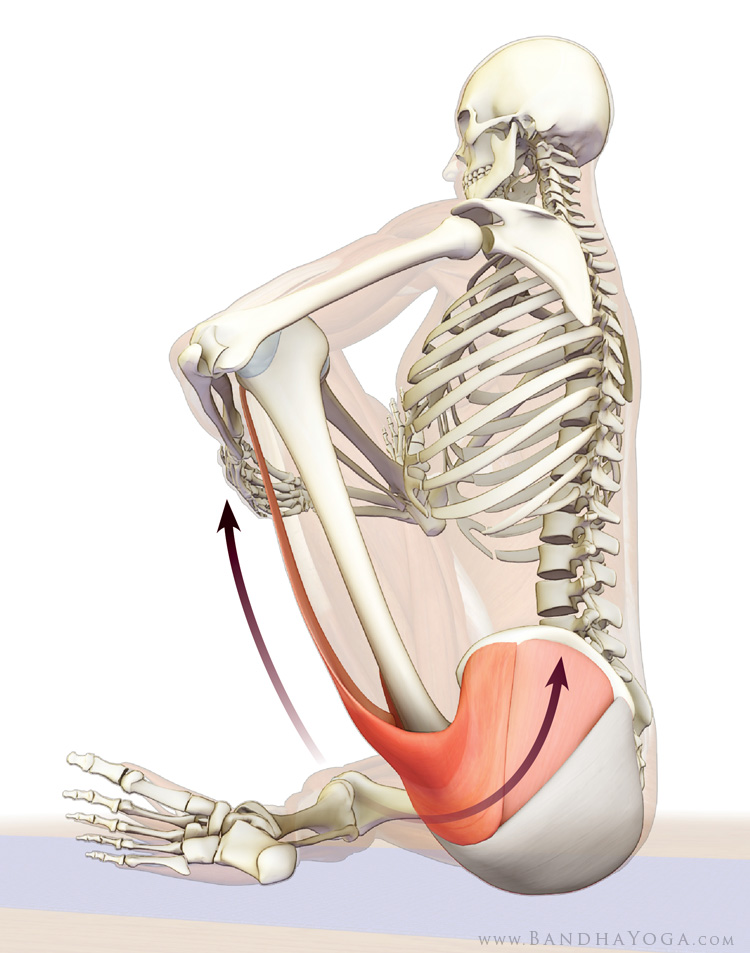
Tensor fascia lata and gluteus medius stretching.
The main muscles that internally rotate the femur at the hip are the tensor fascia lata (TFL) and gluteus medius. The gluteus minimus contributes to this action when the hip is flexed. Conversely, when the internal rotators are tight, they can limit external rotation of the joint, a key component in poses like Lotus. Practicing this asana without releasing the TFL and gluteus medius can lead to excessive joint reaction forces in the knee. This is because the rotational component of the pose is directed into the knee. The key is to use the hip (which is a ball and socket joint) to do the rotation, while protecting the knee by maintaining it as a hinge.

To release the TFL and gluteus medius, I use a technique called the “cradle stretch.” In it we lift the lower leg, as shown here. This action externally rotates the hip. Do not allow the knee to sag forward away from the body—this is important. Cradle it in the crook of the elbow so that the knee is maintained as a hinge. Place the outer edge of the foot into the crook of the other elbow and engage the peroneus longus and brevis muscles at the outside of the lower leg to evert the foot. Extending the toes also helps. This aids to maintain the congruency of the knee joint and helps to protect it from injury.
Cradle stretch with inset of peronei contracting to evert foot.
Take the leg to a point where you feel a moderate stretch in the muscles at the outside of the hip—the TFL and gluteus medius. Hold this position by contracting the biceps, pectoralis major, and latissimus dorsi (shown in blue). Then gradually start to press the edge of the foot into the forearm, as if you were trying to bring it away from the body. This activates the stretching TFL and gluteus medius (shown in red). Build the contraction of these muscles slowly to about 20 percent of your maximum force (or less). Take four to five smooth deep breaths, and then stop pressing the foot into the forearm. At this point you will have elicited the relaxation response through stimulating the Golgi tendon organ at the muscle-tendon junction. Then “take up the slack” by gradually lifting the foot a little higher and drawing the knee a bit further across the body. Hold this new position for a few breaths. Continue to protect the knee as you take it out to the side, bend it, and place it on the floor. Feel the difference between the two hips. Repeat on the other side. Contracting and releasing the stretching muscles uses PNF to lengthen the hip internal rotators. 

Alternative cradle for tight hips.
If you are unable to cradle the leg as shown, don’t despair, and don’t force it. Use the variation illustrated here with the mannequin. Protect the knee with one hand and press the edge of the foot into the other hand. Work like this for as many sessions as necessary until the TFL and gluteus medius have released enough to move into the full cradle. The lower back can tend to collapse into flexion when practicing this stretch. Engaging the erector spinae and quadratus lumborum muscles (extensors of the lumbar spine) will help to protect against this. Note how slightly extending the lumbar also accentuates the stretch of the TFL and gluteus medius.

Remember to go slowly with PNF. Allow about 48 hours for recovery before repeating the technique on any given muscle group. It takes a few sessions for the new length to be ingrained in the body, so don’t get discouraged if you feel a bit tight again when you come back to this position.

Thanks for stopping by. To show our appreciation to all of you who visit us on Facebook, we wish to offer a free copy of our iconic chakra poster (we simply ask that you pay for shipping J). Click here for details.

We’ll see you for the next post when we’ll talk about how to lower the knees closer to the floor in Baddha Konasana (Bound Angle Pose).

Namasté

Ray and Chris

Wednesday, February 2, 2011

Joint Reaction Forces, Padmasana, and the Knees

First, thanks to Julia for the following question: “As a yoga teacher, I often see students in Uttanasana with hyperflexion in the lumbar spine. Aside from helping them work on hamstring flexibility over time, what do you suggest in the moment to help them take the flexion out of the lumbar spine?”
 

Click here for a simple technique on how to use the science behind the muscle spindle to address this common situation.

Now on to Padmasana (Lotus Pose) . . .
Yoga poses such as Padmasana can take your knees to the limit of their natural mobility. The idea is to do this without injuring yourself. Knowledge of anatomy and biomechanics can help. While it’s true that an injury can teach you a lot, I’ve been through that and those are hard lessons. For the rest of this incarnation, I’m opting for the easier lessons (at least with my yoga). We can learn a lot about how to avoid injuries in yoga from the vast fund of information available from sports science.

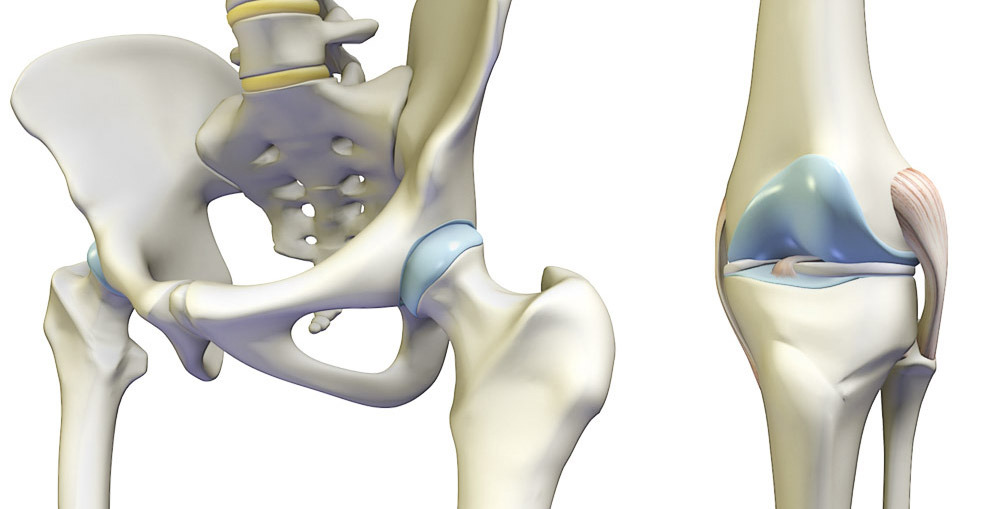
Hip joint and knee joint with meniscus and ligaments.

Joint Congruency
There is a concept in orthopedics known as joint congruency. This refers to joint surfaces maintaining their natural curvature when in contact with one another. A related concept is the joint reaction force. In essence, this is a combination of all of the factors that can produce pressure within a given articulation, such as the hip or knee. These elements include body weight, the contractile force of the muscles that surround the joint, or even someone “assisting” you to get into a pose. When the articulations are taken to extreme positions, the joint reaction forces tend to be concentrated over a much smaller area, creating the possibility of injury. To understand this, imagine 1 pound spread over 10cm2 of surface area versus 1 pound spread over 1cm.2 The force spread over the smaller region is more likely to cause injury. When practicing yoga, it is best to spread the joint reaction forces over a greater area by maintaining maximum congruency of the joint surfaces.


Padmasana (Lotus Pose)
Let’s look at the form of the body in Padmasana: the hips flex, abduct, and externally rotate and the knees flex (and rotate a small amount). The hips are ball and socket joints, enabling them to move in all directions and, especially for this pose, rotate. The knee is a hinge joint with a limited capacity for rotation. Thus we want to protect the knees in Lotus by obtaining most of the rotation from the hips. If the hips are tight, there can be a temptation to force the knees to rotate more than they should, creating a torque at the joint that can injure the articular cartilage and/or ligaments. Maintaining joint congruency of the knee minimizes abnormally high joint reaction forces being concentrated over a small area within the joint and limits stress on the ligaments. You can see from this video that the hip only has to release a small amount to protect the knee.

Tight Internal Rotators
As discussed, Padmasana involves externally rotating the femurs. Look at today’s video to see what happens when the muscles that internally rotate the hip are tight (the tensor fascia lata, gluteus medius, and gluteus minimus). This limits external rotation of the hip, which can compromise congruency of the knee joint. As a result, there can be increased pressure on the cartilage of the medial surface of the knee and abnormal stress on the lateral collateral ligament. Observe how releasing the internal rotators of the hip allows you to maintain the knee as a hinge. This removes the pressure on the inside of the knee and closes the opening on the outside. 

Review facilitated stretching for Janu Sirsasana. Next post we'll illustrate how to use this technique for the tensor fascia lata and gluteus medius. This can help to relieve discomfort and prevent injuries in poses like Padmasana.

Namasté,

Ray and Chris