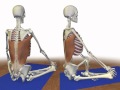
Refining the Pelvis in Twisting Standing Poses
›
Yoga poses are "kinetic keys" that unlock and open the mind/body connection . Precise and accurate renditions of the asanas are mo...
5 comments:
Sitting Up Straight and Expanding the Chest Forward in Sukhasana
›
Slumping the back and collapsing the chest is a common occurrence in Sukhasana, especially in those who are new to yoga. Factors that can c...
40 comments:
Antagonist/Synergist Combinations in Yoga
›
In this post we explore the relationship between the tensor fascia lata (TFL) and the gluteus maximus. In addition I add a cue for engaging ...
8 comments:
Balancing Freedom and Restraint in Yoga
›
The work of legendary furniture designers Charles and Ray Eames has been described as a balance of freedom and restraint. Mr. Eames was o...
2 comments:
Using the TFL to Refine Utthita Parsvakonasana
›
Many of the standing poses have a lunge component; that is, the forward hip and knee flex while the back hip and knee extend. It is not unus...
8 comments:
Shoulder Kinematics in Yoga Part II: The Lower Trapezius and Serratus Anterior
›
Our last blog post used a video to illustrate shoulder kinematics in 3D and reviewed how to externally rotate the humerus to protect again...
8 comments:
Shoulder Kinematics in Yoga, Part I
›
The shoulder is the most mobile joint in the body. It is a combination of several articulations: the glenohumeral, scapulothoracic, sternoc...
20 comments:
How to Use the Adductor Muscles to Refine Downward Dog
›
In our blog post, " Strong Thigh Muscles Benefit People with Knee Osteoarthritis ,” we gave a tip for activating the tensor fascia la...
6 comments:
Satya, Biomechanics, and Yoga
›
“One who shows a high degree of right communication will not fail in his actions.” (T.K.V. Desikachar’s translation of Yoga Sutra II.36...
3 comments:
Balancing the Forearms, Wrists, and Hands in Dog Pose
›
A starting point for combining Western science with yoga lies in the term Ha/Tha. This Sanskrit word means Sun/Moon or Yin/Yang and implies ...
5 comments:
A Tip for Helping to Correct Alignment in Hyperextended Elbows and Knees in Yoga
›
Aligning the bones accesses their inherent strength so that yoga poses ultimately require less muscular effort to maintain. For example, in...
14 comments:
A Benefit of Using the Big Toes in Yoga
›
Have you ever noticed how the pelvis seems to drift backwards in standing forward bends, especially Uttanasana? Sometimes you get an assis...
19 comments:
Strong Thigh Muscles Benefit People with Knee Osteoarthritis (and a Tip for Engaging the TFL)
›
A series of recent articles from opinion leaders in the academic medical community have demonstrated the benefits of quad strength for per...
10 comments:
How to Balance Opposites in the Foot and Ankle
›
I think that one of the keys to a unified theory lies in the name Hatha—sun/moon and balancing opposites. Here’s a tip on balancing them for...
13 comments:
The Importance of Theory (and Another Cool Tip for Deeper Breathing)
›
First, I want to thank Ashtanga instructor Robin Feinberg for her comment in which she states: “ …‘when the going gets tough, Ashtangis bre...
8 comments:
Here’s a Tip to Help You Lower Your Heels Down in Dog Pose
›
Say you’ve been working hard on your Downward Facing Dog and still can’t get your heels to the floor. This cue can give you and your st...
12 comments:
A Cool Tip for Deeper Breathing in Yoga
›
First, heartfelt thanks for all of your “likes” and comments on our Facebook page . We’ve heard from practitioners all over the world on h...
23 comments:
Combining Science and Yoga—Some Personal Reflections (and a FREE E-Book!)
›
In this blog post, I go over some of my own experiences with combining Western science and yoga, but first we wanted to let you know that...
4 comments:
How to Draw the Knees to the Floor in Baddha Konasana
›
In Yoga Mat Companion Book 2 ( Anatomy for Hip Openers and Forward Bends ) , I mention an old Chinese proverb that says, “If you are unabl...
8 comments:
How to Release the Hip Internal Rotators for Padmasana (Lotus Pose)
›
In The Key Muscles of Yoga , I point out that athletes experience improved performance and fewer injuries when they have a fundamental know...
20 comments:
Joint Reaction Forces, Padmasana, and the Knees
›
First, thanks to Julia for the following question: “ As a yoga teacher, I often see students in Uttanasana with hyperflexion in the lumbar ...
1 comment:
The Mind—Body Connection in Yoga
›
Many of the benefits of practicing yoga cannot be explained by modern Western science—especially the mystical aspects. Nevertheless, an adv...
4 comments:
How to Lengthen the Hamstrings in Janu Sirsasana
›
In our previous post , we discussed how tight hamstrings can produce hyperflexion of the lumbar spine in forward bends such as Uttanasana. ...
8 comments:
How Tight Hamstrings Affect Your Lumbar Spine
›
Hello Friends, Here's a quick 2016 update from the science literature on your hamstrings... Biomechanically speaking, tight hamstr...
13 comments:
How to Use the Abdominals to Release the Back in Uttanasana
›
I used to quote the writer, Emily Dickenson, as saying, “See the world in a grain of sand…” Then a friend of mine explained that, actually, ...
9 comments:
How to Use Nutation to Refine Uttanasana, Part III—A Fringe Benefit
›
In our last post, Part II of this series on Uttanasana, we gave a trick for engaging the tensor fascia lata (TFL) and gluteus medius. Cont...
11 comments:
How to Use Nutation to Refine Uttanasana, Part II—the Tensor Fascia Lata and Gluteus Medius
›
In the last post, I talked about how masters of various disciplines are continuously refining their art—even though they are masters. I foll...
17 comments:
How to Use “Nutation” to Refine Uttanasana—Part I
›
Many moons ago I had the privilege of spending an extended period studying yoga at the Ramamani Iyengar Memorial Yoga Institute in Pune, ...
15 comments:
How to Use Your Shoulders to Deepen Uttanasana
›
In Uttanasana, fix the hands onto the mat and attempt to drag them forward. This contracts the anterior deltoids and draws the upper body ...
20 comments:
‹
Home
View web version